
Landscape stewardship for water and grassland management strategies (WP2)
Work package two of the project Save the tiger, Save the grasslands, Save the water on Landscape stewardship for water and grassland management strategies has been active in community landscape stewardship which has resulted in two poetry routes and a serious game.
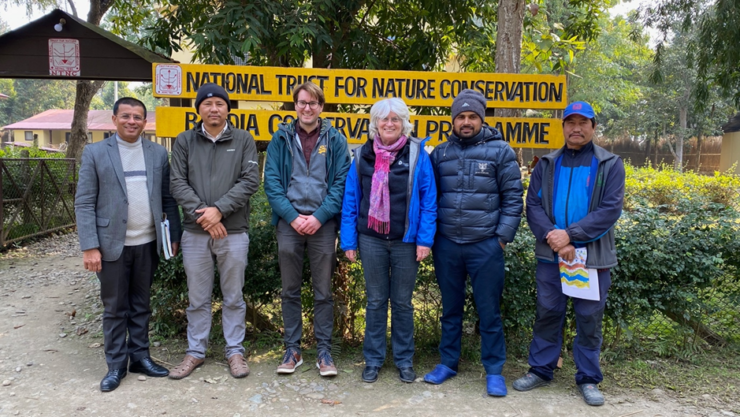
With the objective to compare the procedures and principles of the Terai based poetry route In the Buffer zone Farms, Families and Wildlife the WP2 team moved North. Facilitated by the transfer of NTNC colleague Umesh Paudel from Bardia to the Annapurna conservation area and thereby with a change of focus from tiger habitats to snow leopard habitats. Following with the same methodology of community art for voicing and social dialogue the poetry route Welcome to Namasung and Dhye. Our mountain villages has been created. The research seems to indicate that under similar natural conditions of communities challenged to engage actively with wildlife conservation while striving for their livelihood, this approach offers a methodology to support social-ecological dialogue and learning.
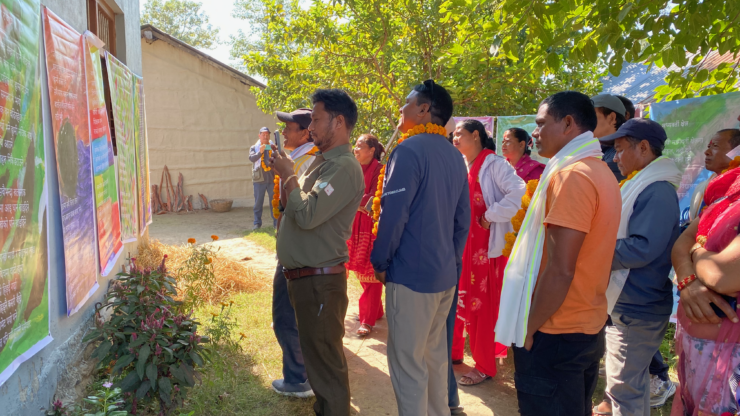
Community members in Dalla engage with the final production of their Poetry Route
With Prakash Raj Bista, Ajit Tumbahangphe, Jan Fliervoet, Walter Verspui, Umesh Paudel and Naresh Subedi we documented the experience with the Bardia poetry route and the serious game RiverSideVillage in the chapter Community art and communication: crafting sustainable landscape stewardship in Terai Arc, Nepal in Collaborative Change: Towards Inclusive Rural Communication Services, a book published by FAO and IAMCR.
The chapter is published in part II focusing on participatory, inclusive and negotiated qualities of the approaches and strategies. Our chapter 8 adopts the RCS framework and zooms in on the design and facilitation of two innovative community-art-based RCS strategies: serious gaming and poetic-inquiry.
These RCS strategies are applied in the NWO funded project exploring rural communication and mediated participation in the Terai Buffer Zone in Nepal integrating the social-ecological context and rural communication processes into stewardship strategies for family farming in an area near tiger habitats in Nepal’s natural reserves, integrating a nature-conservation perspective with a rural-livelihoods perspective. Through the two innovative, community-art-based RCS strategies, the farming families express how they interact with water systems, natural grasslands and wildlife populations in the buffer zone. Participation and horizontal communication are central to the strategies, and facilitators are seen as process designers, creating space and crafting routes for change. Based on the two community-art methodologies, the voices of farming families are heard through active social imagination.
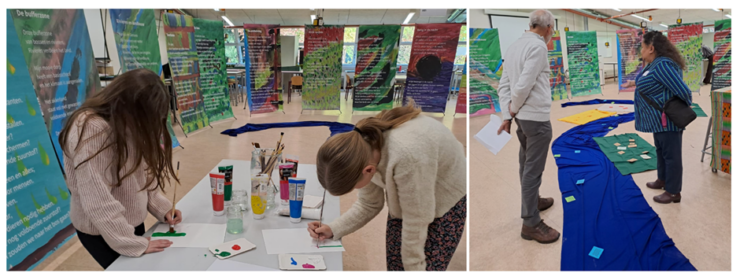
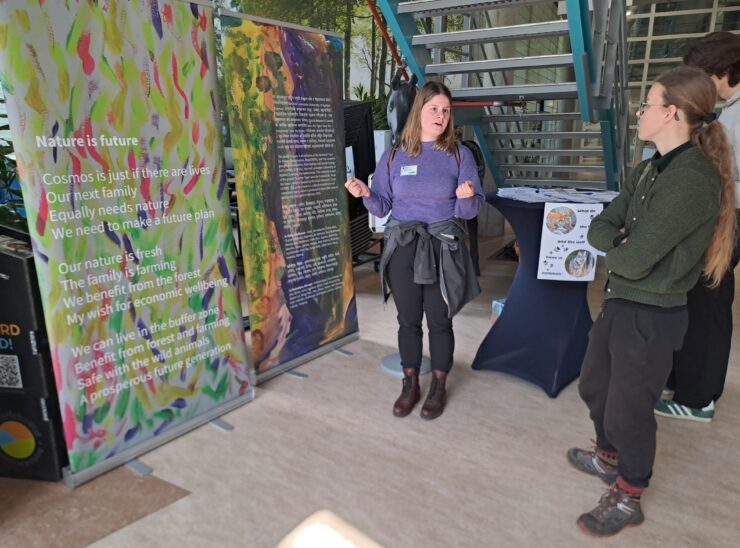
With the results of WP2 it is currently explored how to transfer the community experiences to other realities and issues of human-wildlife conflicts. A Dutch language version of the poetry route In the Buffer zone Farms, Families and Wildlife has been exposed during the Sustainability festival organised by the Municipality of Rheden. The poetry route was complemented with a banner with the poem Wolf and summer bird. Children were invited to paint nature themes while adults observed the poetry route and engaged in conversations on stewardship and wildlife conservation. In the centre of the exhibition hall the serious game RiverSideVillage was exposed and turned out to create a rapid insight on the Terai eco-system and the challenges for the families in the buffer zone. The experiment to bring the Nepali stewardship narrative to the Netherlands, where the societal debate over the presence of the wolf features high on the agenda, seems promising. We will further explore if the Nepali poetry route may inspire similar stewardship debates as NTNC is dedicatedly thriving for in the Terai. Based on these outcomes the poetry routes and the serious game are being presented at occasions such as the Rewilding our World conference (September 2025) and the Future for Nature Academy Day (May 2026). Visual Research Methodologies Guest lectures for Nepali students (Kathmandu November 2025) and with Dutch students of the bachelor programme Forest and Nature conservation, the minor International Wildlife management and a PhD course confirm both the interest of higher education students as well as the absence of curriculum coverage of such transdisciplinary methodologies in contemporary education. Interns at VHL are inspired by the poetry routes to explore a similar methodology for enriching the debate on the human-wildlife interactions in the Netherlands. Students are hereby focusing on the wolf and the beaver in Dutch regions.
For social media appearances: click on guest lecture and poetry route and serious game presentation.
A follow up research activity is focusing on developing procedures of facilitating the poetry routes and the serious game as a communicative strategy for social dialogue at regional level Bardia National Park Annapurna Conservation Area (ACA) and beyond. A line of research will focus on elaborating on the facilitation of using the poetry routes for diverse audiences, ranging from policy makers to higher education students.
Based on the positive evaluation and requests by NTNC and Nepali Ministry of Forestry the option is explored to design and implement a training on the methodologies for rural communication services including poetic inquiry, serious gaming and social imaginaries for stewardship, whereby we specifically build on the experiences obtained with the design and development of the poetry routes and RiverSideVillage the game.