
Integrative water management approaches under conflicting views (WP1)
As rainfall grows more unpredictable and temperatures rise, tigers and people in many of South Asia’s national parks are running short of the same resource: water. In the buffer zones around Nepal’s Bardia National Park, this scarcity is fuelling human–wildlife conflict. Indushree Banerjee, a postdoctoral researcher at TU Delft, studies the conflict and which conservation policies can ease it. She develops agent-based models of tiger habitats, integrating ecology, hydrology, and on-the-ground knowledge from field visits and stakeholder workshops with community forest groups and park staff. Alongside this, she supervises master’s-thesis work on irrigation challenges and on women’s access to domestic water in the same buffer zone.
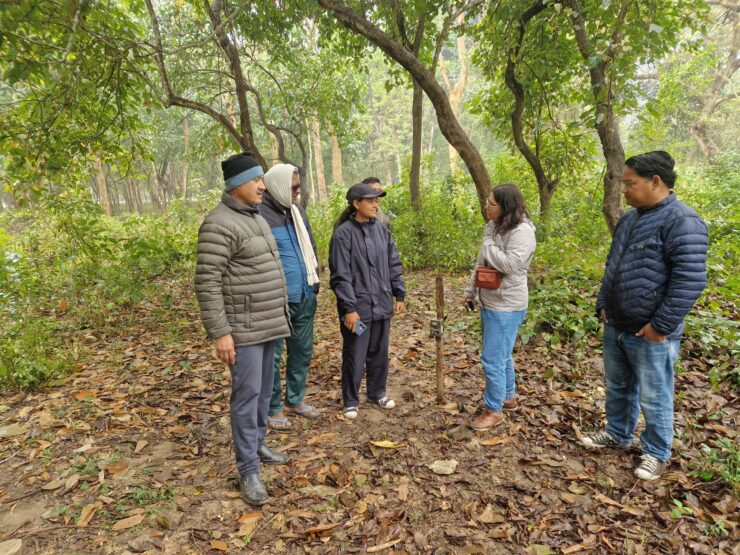
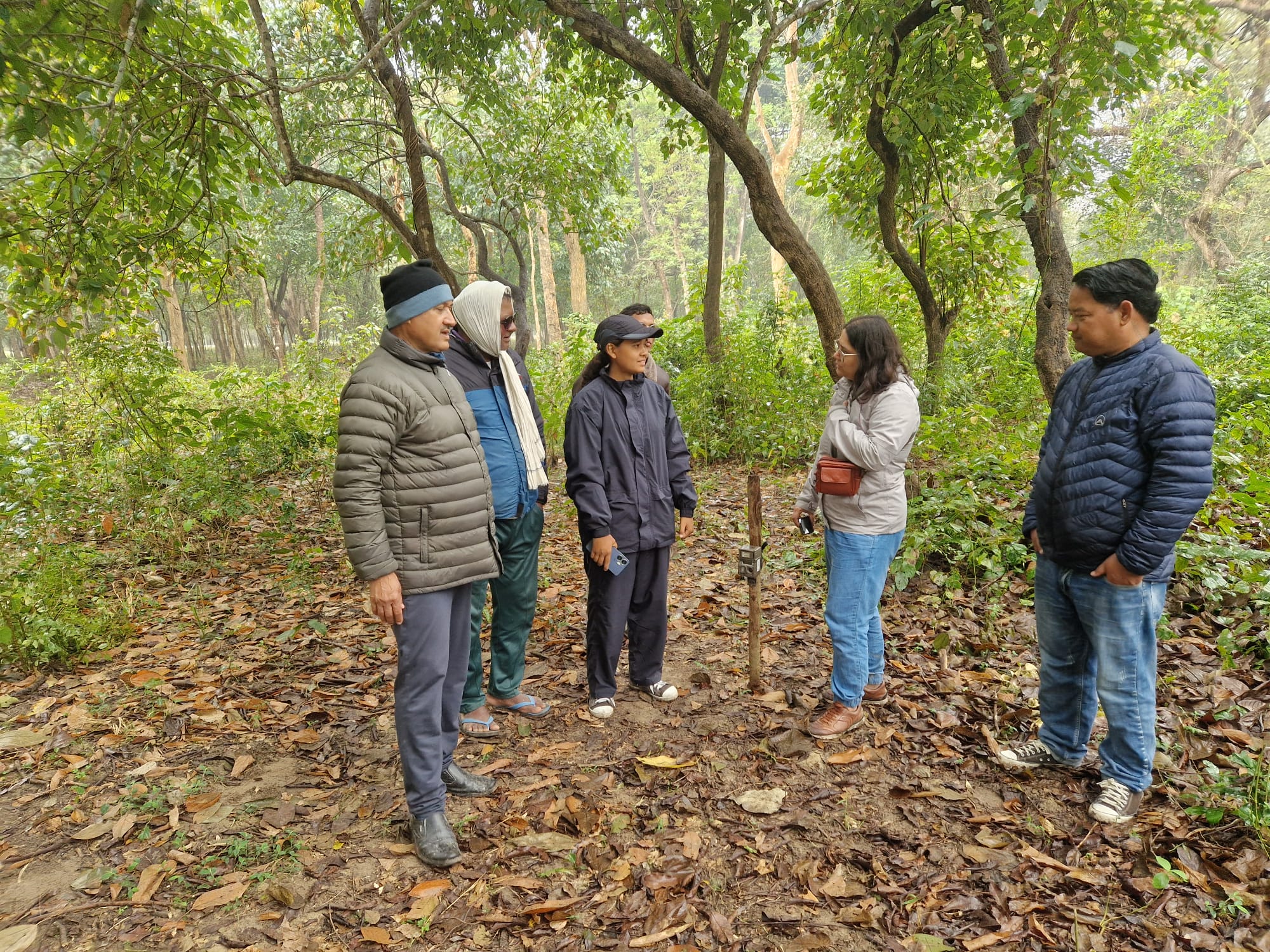
Figure 1: Together with the community in the forest
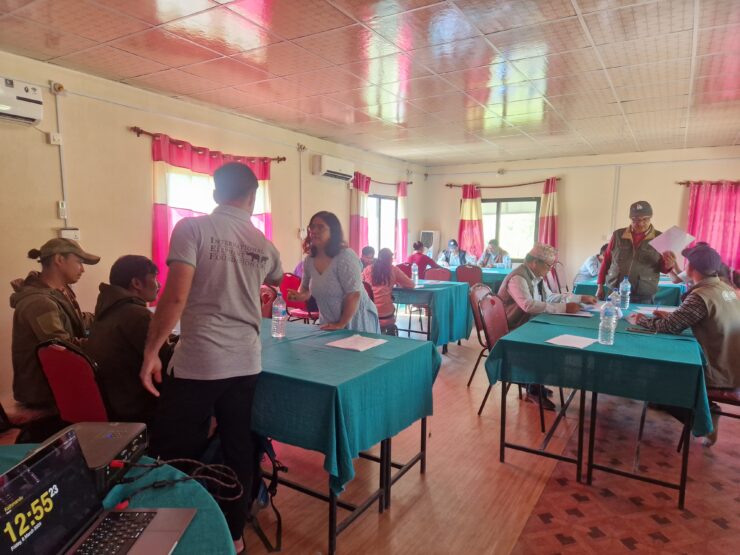
Figure 2: Workshop for validating model with local stakeholders
Indushree’s first tiger model was built from literature data, with imposed territory sizes and geometric home ranges. When she brought it to workshops in Bardia’s buffer zones, communities told her that territory is not geometric. It is ephemeral and responsive, shaped by what the tiger needs on that particular day. That single observation restructured the model. To elicit behavioural mechanisms directly from practitioners, Indushree developed an 80-question participatory framework used with park rangers, anti-poaching units, nature guides, conservation officials, and community members. Their answers became the model’s rules.
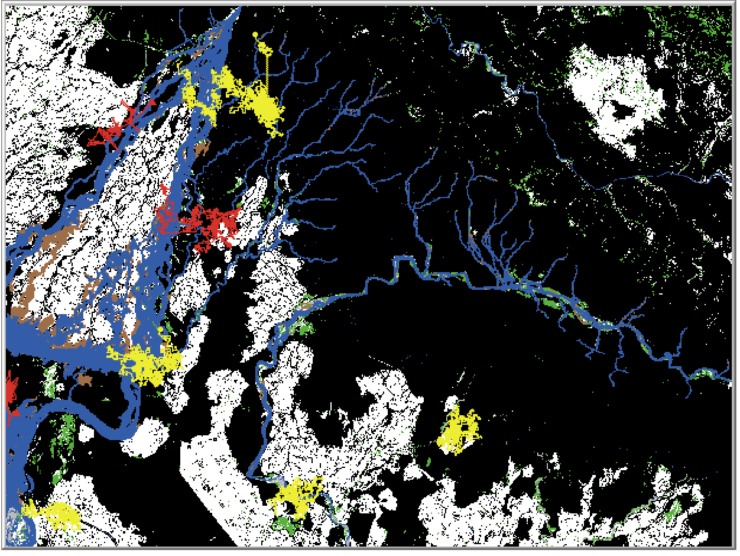
Figure 3: The BaghSim model with seasonality of rivers and movement of tigers leading to emergence of territories (male in yellow, female in red).
Indushree developed BaghSim, an agent-based modelling platform that simulates how individual tigers move, hunt, and breed within national parks. BaghSim represents tigers and their environment in detail: territory, dispersal, and the seasonal availability of rivers and prey. Tiger territorial and demographic patterns emerge from two behavioural principles, spatial memory and need-based movement, without imposing population-level assumptions. The platform has been coupled with HEC-RAS hydrological simulation to predict how seasonal changes in river flow compress tiger habitat and increase proximity to human settlements, making it one of the first eco-hydrological agent-based models for large carnivores. BaghSim predicts in ranges rather than single values, so the places where stakeholders’ assumptions are wrong become visible before any intervention is built. The same process also surfaced something often missed in this kind of modelling: seemingly innocuous choices, such as meters versus kilometers or days versus years, can lead to incompatible policy recommendations.
BaghSim can be used as a boundary object in policy discussions, letting park managers, conservation officers, and government representatives test waterhole placement, fencing, and corridor design before committing to them. Beyond the scientific community, BaghSim also informs a serious game at Diergaarde Blijdorp (Rotterdam Zoo), embedded in the zoo’s Asian Corridors impact area. The game lets children explore how landscape changes affect human–wildlife coexistence and habitat connectivity.
Indushree is preparing BaghSim for open release and aims to train park staff to use it directly in Bardia and in partner reserves across India. She leads Ruimte voor de Tijger (Room for the Tiger), a TU Delft Climate Action seed grant awarded to 5 of 100 applicants, which is forming a consortium across TU Delft, IZW Berlin, UFZ Leipzig, NCBS Bangalore, the Wildlife Trust of India, and the Wildlife Institute of India. The consortium is collecting pilot genetic data from historical tiger specimens to make genetic connectivity a quantitative parameter in conservation and infrastructure planning. The longer-term goal is a digital twin of national parks where managers, policymakers, and communities can explore climate and habitat scenarios before committing to interventions.