
Scientific articles and book chapters
Bijlmakers, J., Griffioen, J., and Karssenberg, D.: Environmental drivers of spatio-temporal dynamics in floodplain vegetation: grasslands as habitat for megafauna in Bardia National Park (Nepal), Biogeosciences, 20, 1113–1144, https://doi.org/10.5194/bg-20-1113-2023.
Disturbance-dependent grasslands, often associated with hydromorphological and fire dynamics, are threatened, especially in subtropical climates. In the Nepalese and Indian Terai Arc Landscape at the foot of the Himalayas, natural and cultural grasslands serve a viable role for greater one-horned rhinoceros (Rhinoceros unicornis) and for grazers that form prey of the Royal Bengal tiger (Panthera tigris).
The grasslands are vulnerable to encroachment of forest. We aimed to establish the effects of environmental drivers, in particular river discharge, river channel dynamics, precipitation and forest fires, on the spatio-temporal dynamics of these grasslands. The study area is the floodplain of the eastern branch of the Karnali River and adjacent western part of Bardia National Park. We created annual time series (1993–2019) of land cover with the use of field data, remotely sensed LANDSAT imagery and a supervised classification model.
Additionally, we analysed the pattern of grassland patches and aerial photographs of 1964. Between 1964 and 2019, grassland patches decreased in abundance and size due to encroachment of forest. Outside the floodplain, conversion of grassland to bare substrate coincides with extreme precipitation events.
Within the floodplain, conversion of grassland to bare substrate correlates with the magnitude of the annual peak discharge of the bifurcated Karnali River. Since 2009, however, this correlation is absent due to a shift of the main discharge channel to the western branch of the Karnali River. Consequently, alluvial tall grasslands (Saccharum spontaneum dominant) have vastly expanded between 2009 and 2019. Because the hydromorphological processes in the floodplain have become more static, other sources of disturbances – local flooding of ephemeral streams, anthropogenic maintenance, grazing and fires – are more paramount to prevent encroachment of grasslands. Altogether, our findings underscore that a change in the environmental drivers impact the surface area and heterogeneity of grassland patches in the landscape, which can lead to cascading effects for the grassland-dependent megafauna.
Banerjee, I., Ertsen, M., Scale choices shape species adaptation predictions: Improving conservation modeling under global change, Conservation Science and Practice 8(2), 2026, https://dx.doi.org/10.1111/csp2.70193
Ecological models must mimic observed patterns to predict species responses to global environmental change. However, the observation of patterns is scaledependent, which poses a fundamental challenge for conservation policy under increasing anthropogenic pressure. This paper examines how choices on temporal and spatial modeling scales affect our understanding of species adaptation to changing environments, using tiger conservation in Nepal’s Bardia National Park as a case study.
Case study analysis revealed how tigers adapt to climate-driven habitat modification through mechanisms invisible at coarse modeling scales. Different temporal scales uncovered distinct patterns of human-wildlife coexistence, while spatial scales shaped our understanding of how habitat connectivity affects adaptation. This scale dependency of observation determines which processes we can discover and predict. We provide four novel recommendations for scale-aware ecological modeling under global change: explicit documentation of scale contexts, probability models to compensate for abstraction, sensitivity analyses of scale choices, and connected models across scales.
Pokhrel P, Griffioen J, Bogaard TA, Kraaijenbrink PDA, Fiddes J and Immerzeel WW (2026) Upstream hydrology and the importance of snowmelt in buffering droughts in the Karnali basin in Nepal. Front. Water 7:1720178. https://dx.doi.org/10.3389/frwa.2025.1720178
Understanding the hydrology in the upstream mountainous part of the Karnali basin in Nepal is vital, considering the importance of streamflow for downstream nature conservation and water supply. We use a fully distributed hydrological model to understand the current hydrology, the associated vulnerability of the basin, and the importance of the different hydrological components in regulating flow.
Downscaled ERA5 meteorological data is used to force the model for the period 1991–2022 at a high spatial resolution (500 meters). We calibrate our model using observed discharges, and the model performance is considered good with a reported Kling-Gupta efficiency of 0.84 and a bias of −3.33%. Our results show that 40% of the overall discharge generated in the Karnali basin originates from rain runoff, 35% from baseflow, 24% from snowmelt, and a negligible 0.8% from glaciers. The water balance components vary spatially in magnitude, but the overall monthly patterns are comparable. On average, the basin receives 1,485 mm/ year of precipitation, peaking in July, and is a pronounced southwest region. The annual average evapotranspiration in the basin is 574 mm/year, and discharge is 914 mm/year. Analysis of anomalies reveals that the discharge has become increasingly more variable over the last decades and, therefore, less predictable.
Our results also reveal that the basin is frequently experiencing meteorological droughts, often translating into a hydrological drought with a lag time of a month. The average duration of a hydrological drought period in the basin was about 6 months. Snow storage plays an important role in modulating these droughts, and variability in initial snow storage impacts basin streamflow for up to 6 months. A climate change-induced shift from snow to rain may therefore impact the climate resilience of the Karnali considerably.
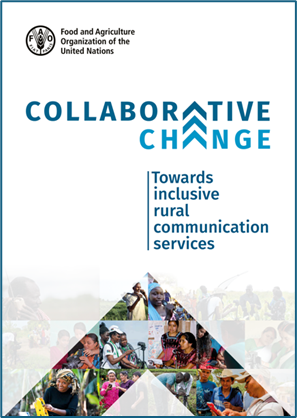
With Prakash Raj Bista, Ajit Tumbahangphe, Jan Fliervoet, Walter Verspui, Umesh Paudel and Naresh Subedi we documented the experiences with the poetry route and with RiverSideVillage the in the chapter Community art and communication: crafting sustainable landscape stewardship in Terai Arc, Nepal in Collaborative Change: Towards Inclusive Rural Communication Services, a book published by FAO and IAMCR.
The chapter is published in part II focusing on participatory, inclusive and negotiated qualities of the approaches and strategies. Our chapter 8 adopts the RCS framework and zooms in on the design and facilitation of two innovative community-art-based RCS strategies: serious gaming and poetic-inquiry.
These RCS strategies are applied in the NWO funded project exploring rural communication and mediated participation in the Terai Buffer Zone in Nepal integrating the social-ecological context and rural communication processes into stewardship strategies for family farming in an area near tiger habitats in Nepal’s natural reserves, integrating a nature-conservation perspective with a rural-livelihoods perspective. Through the two innovative, community-art-based RCS strategies, the farming families express how they interact with water systems, natural grasslands and wildlife populations in the buffer zone. Participation and horizontal communication are central to the strategies, and facilitators are seen as process designers, creating space and crafting routes for change. Based on the two community-art methodologies, the voices of farming families are heard through active social imagination.
The book is freely available at: https://openknowledge.fao.org/items/dc9b65ff-4bfd-4595-9c0b-e53e17f5d803
Conferences | Presentations and posters
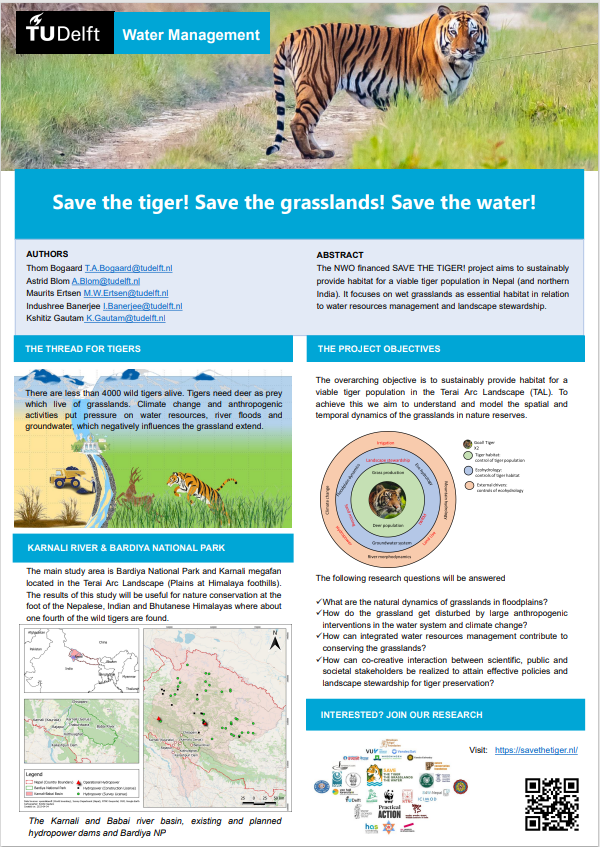
General overview of the project “Save the tiger! Save the grasslands! Save the water!”, by Thom Bogaard, Astrid Blom, Maurits Ertsen, Indushree Banerjee and Kshitiz Gautam
April 2023